
Whether you’re a school administrator, preschool principal or day care owner, you do everything possible to protect the children in your care. But there may be an invisible threat affecting both your students and staff. According to the U.S. Environmental Protection Agency (EPA), one in five schools nationwide has at least one room with radon levels above 4pCi/L. Long-term exposure to this radioactive gas can cause respiratory issues and may exacerbate preexisting conditions.
In this guide, we’ll explore the origin of radon, the why and how of radon testing in schools, and how mitigation can help create a safer space.
Why Is Radon a Significant Risk in School Buildings?
Radon is a naturally occurring gas in the soil that enters buildings through structural cracks and gaps. It affects lung health by sticking to the cells and impairing normal function. The EPA estimates that this gas is the leading cause of lung cancer for nonsmokers in the United States. The risk of radon is highest in lower-level rooms, such as basement classrooms and first-floor cafeterias, because these spaces are closest to the soil where radon develops.
Although radon exposure affects all ages, its impact on children can be more significant. Children have smaller lungs that are still developing. They also have faster respiratory rates, which means higher concentrations of radiation enter their lungs. However, even with this increased risk, only 20% of schools have been tested for radon.
The First Step to a Safer School
Radon is odorless, colorless and tasteless, so the only way to determine the radon levels in a school is through testing. Testing gives you and your staff a clear picture of the level of risk in rooms so you can identify the need for effective mitigation processes.
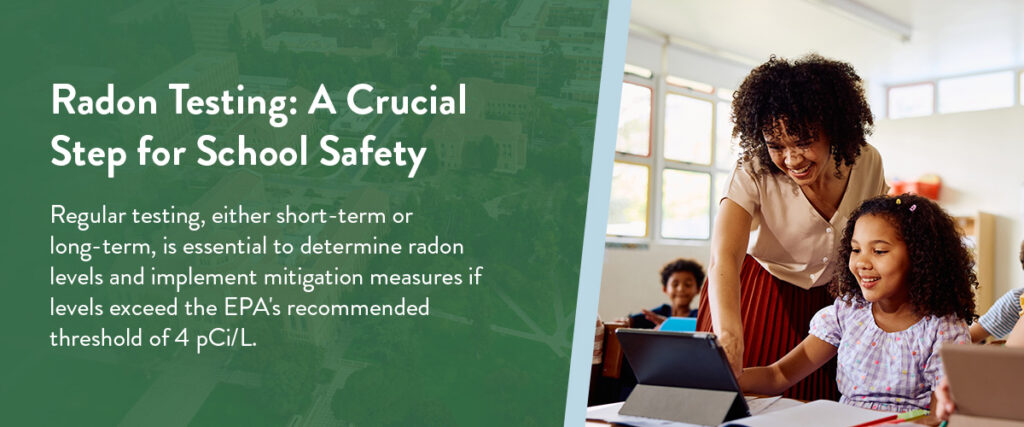
There are two types of tests you can run. One is short-term, providing a quick radon snapshot in two to seven days. It might make sense to use a short-term kit if you suspect a problem and need quick verification. The other option is a long-term test that measures radon levels over a minimum of 90 days, offering more accurate readings.
Radon is measured in picocuries per liter (pCi/L), and the EPA strongly encourages mitigation at 4 pCi/L and higher. While there is no safe level, the 4 pCi/L threshold is considered a significant health risk.
Some states have incentives to encourage radon testing in schools and other buildings. For example, Montana offers subsidized test kits, while other states may offer free kits during January, the official awareness month. Check with your local health department or state office to understand the specific requirements and support available to your school.
When and How to Test for Radon
We advise administrators to complete school radon testing during the cooler months when doors and windows are usually closed. Testing during these months will provide more accurate results.
The best place for radon test kits is in the most occupied rooms on the lowest levels. Once you have identified your target rooms, keep them closed for at least 12 hours before beginning your tests. Do not open the kits until you are ready to use them.
To determine average radon levels in your school, maintain closed-building conditions throughout the testing period. You may use doors for entry and exit, but keep all windows closed throughout the test. We also advise schools to limit the use of their HVAC systems, as it may impact the accuracy of your results.
What to Do After Discovering High Radon Levels
If you discover readings of 4 pCi/L and above, remain calm. Radon levels can be effectively lowered.
Step 1: Verify the Results
After receiving high radon readings, the first step is to run a confirmatory test. You can either run another long-term test yourself or hire a professional to help you handle the retesting. The advantage of working with a professional is that they may have access to more specialized tools with advanced technology to give you precise results.
Step 2: Understand the Goal Is Reduction
If your follow-up test confirms high readings, communicate your findings with parents, caregivers, staff and the board. Ensure all stakeholders understand that there is a fast, simple and effective resolution to the problem. Since radon is a naturally occurring gas, mitigation will not entirely eliminate it, but it can significantly reduce levels and keep them lower.
Radon mitigation in your school is not a disruptive process that calls for an extended shutdown. When done by a professional team, mitigation can take as little as a day without excessively disturbing typical school activities.
Step 3: Partner With a Certified Professional
We wouldn’t advise attempting DIY mitigation. Schools are large buildings with complex architectural designs. You will need a certified professional with experience and expertise working on commercial buildings to help you install an effective system that will protect your staff and students.
Radon Mitigation in Schools
Several mitigation systems are available from leading experts, depending on factors like budget and your school’s design. A popular choice for schools is the sub-slab depressurization method, which draws radon from the basement through a network of chambers and a specialized fan.
This type of mitigation system connects to the building’s foundation and uses a fan to create a vacuum. The vacuum pulls the gas from the soil and safely vents it above the roof before it can enter the spaces students and staff inhabit.
Sealing and caulking cracks in the foundation are two additional measures a professional may take to protect your learning environment. Although sealing is an effective additional solution, it is not a stand-alone reduction method. It is an enhancement step to protect your space further. A professional mitigation specialist may also suggest adjusting your school’s HVAC system to bring more fresh air into the building.
For the most effective results, remember to retest after mitigation and then again every five years so you can adjust your strategy if needed.
Take the First Step Toward a Healthier Learning Environment
You don’t need to wait for National Healthy Schools Day to ensure a safe learning space. Radon testing is a proactive step that school and day care leaders can take to protect their staff and students.
If the results reveal radon levels of 4 pCi/L or higher, SWAT Environmental can help. As certified technicians who meet multiple state requirements, we are a nationwide leader in radon mitigation services. Get in touch today and learn how we can reduce radon levels in your school.