

May marks National Clean Air Month, and what better time to take a closer look at the air you breathe? While dust, pet dander and outside pollutants all contribute to poor air quality, so does a more dangerous threat lurking in many homes — radon, an invisible, odorless and tasteless gas.
According to the EPA, we spend approximately 90% of our time indoors, making indoor air quality critical to our health. That’s why understanding radon is so important. Learn what radon is, why it’s so dangerous and how you can protect your family this month and onward.
What Is Radon?
Radon is a naturally occurring radioactive gas that forms when uranium in soil, rock and water decays. It’s colorless, odorless and tasteless, which means you can’t detect it without specialized testing equipment.
In outdoor environments, radon poses little danger because it disperses quickly into the atmosphere. The situation changes indoors, where radon can become trapped and accumulate to harmful levels. Any home can have this problem — new or old, well-sealed or drafty, with or without a basement.
Where Does Radon Come From?
The journey begins deep underground. As uranium naturally decays in soil and rock, it produces radium, which then breaks down into this dangerous gas. Once released from the ground, it can seep into buildings through cracks in foundations, gaps around pipes and other openings. Because the amount of uranium underground differs by location, radon risk is ultimately determined by your property’s unique geology. As a result, even neighboring houses can have dramatically different radon levels.
Radon’s invisibility is what makes it so dangerous. Unlike smoke, mold or chemical odors, it provides no sensory warning signs. You can’t see it hanging in the air, smell it when you enter a room or taste it in drinking water. Radon levels in your home depend on the underlying geology and building factors, regardless of how clean your home appears.
The Hidden Health Dangers of Radon Exposure
Radon is a proven health hazard and a serious air quality concern. According to the EPA, it’s the leading cause of lung cancer among nonsmokers and is responsible for about 21,000 lung cancer deaths in the United States each year. The danger is even greater for smokers, who are 10 times more likely to develop lung cancer than nonsmokers exposed to the same radon levels.
Breathing radon-contaminated air allows radioactive particles to settle into the delicate tissue of the lungs, where they become trapped. As these particles emit radiation, they gradually harm the cells lining the airways — a process that may not produce symptoms for decades. The greater the exposure and the higher the concentrations, the higher the risk for developing lung cancer.
National Clean Air Month: Is Your Air Truly Safe?
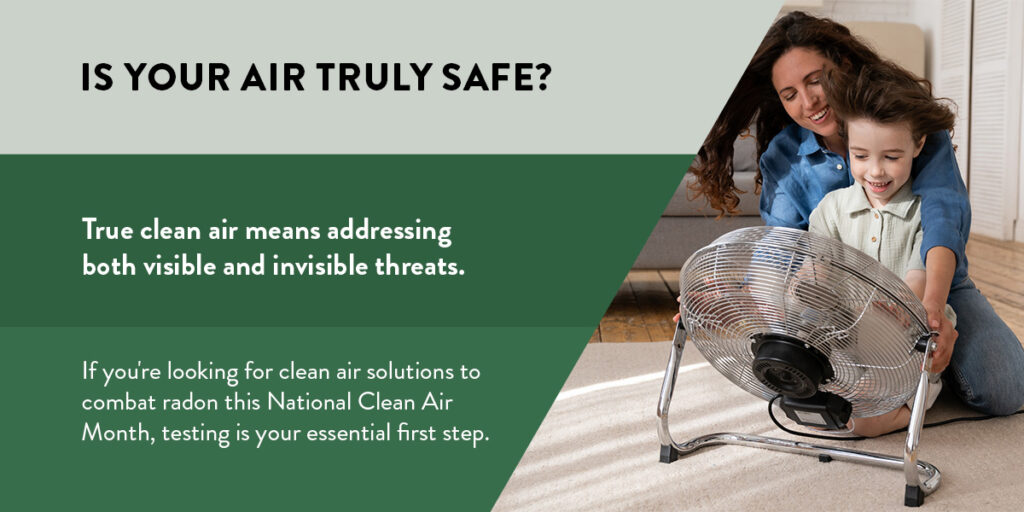
National Clean Air Month 2026 is the perfect opportunity to take a comprehensive look at your home’s air quality. Many homeowners focus on filtering out dust, controlling humidity to prevent mold or reducing volatile organic compounds from household products.
These steps are important, but because radon comes from the ground beneath your home, you can’t control it through cleaning or ventilation alone. True clean air means addressing both visible and invisible threats. If you’re looking for clean air solutions to combat radon this National Clean Air Month, testing is your essential first step.
Why Testing Is the Only Way to Know Your Home’s Radon Levels
The only way to know if you have a radon problem is to test your home. You can’t make assumptions based on your neighbor’s test results, your home’s age or how well-maintained your property is.
Radon testing provides accurate, reliable results that tell you exactly what you’re dealing with — and if your levels are high, the good news is that you can fix the issue. Modern radon systems are highly effective at cleaning the air and reducing concentrations to safe levels.
How Does Radon Testing Work?
Radon testing is simple and noninvasive and includes these steps:
- Device placement: You’ll place a specialized testing device on the lowest occupied level of your home, with guidance from a professional if needed. Leave the device for the specified period, keeping windows and doors closed as much as possible.
- Lab analysis: After the test, follow the included instructions to seal the device and return it by mail to the designated laboratory.
- Detailed results: You’ll receive a detailed report showing your home’s radon concentration, measured in picocuries per liter (pCi/L).
The entire testing and mitigation process is designed to be easy and stress-free and provide the information you need to make decisions about your family’s health.
Understanding Your Radon Test Results
Your radon test results will show a numerical value representing the average radon concentration in your home. Here’s what you need to know about interpreting the results:
- 4 pCi/L and above: The EPA has established an action level of 4 pCi/L. If your home’s radon level is at or above this threshold, the EPA recommends taking steps to reduce it.
- Below 4 pCi/L: Even if your results come back below 4 pCi/L, you might consider mitigation if your levels are close to the action level, especially if you have smokers in the household or plan to finish a basement or lower level for regular use.
Understanding your results helps you take action. High radon levels indicate it’s time for mitigation — a straightforward solution that delivers lasting peace of mind.
This Clean Air Month, Don’t Guess — Test With a Kit From SWAT Environmental
Cleaning your home’s air and protecting your family starts with a test. You can’t see, smell or detect radon, but you can catch it with a test. At SWAT Environmental, we’re the nation’s largest radon mitigation provider with over 30 years of experience. We offer free radon testing kits you can use to determine your home’s radon levels.
As a nationally present company with locally based teams, we understand the radon risks unique to your region and are prepared to address them with precision and expertise. From expert advice on testing to mitigation system installation, we’ll guide you through every step with clear communication and reliable support.
Ready to combat radon during National Clean Air Month? If you find high radon levels in your home, get in touch with our team and take the first step toward truly clean, safe air.